From Mark Trapp · Fall 2024
Turkeys
For our twelfth consecutive year we are offering Thanksgiving turkeys — fed only organic feed, moved daily to fresh pasture, given clean water (no trivial task with turkeys), and grit to help grind up the never-sprayed forage and insects they consume. We feel their quality of life and the resulting taste is unparalleled. On top of that, we have fun raising them and marvel at how they help to transform our soils. We are asking $5.50/lb for turkeys.
Most turkeys range in size from 15–20 lb. Turkeys will be available the evening of Sunday, November 24th. The week of pickup we will send out a reminder email with a half-hour pickup time slot between 5pm and 8pm.
It is a limited year for produce, but that evening we are looking forward to offering brussels sprouts, cabbage, and garlic, all grown here. If you would like to order a turkey, reply to this email and confirm you will be able to pick it up at the farm on Sunday, November 24th. Due to very limited refrigeration, it is very important that someone comes that evening. Please specify if you want the neck and/or giblets (1 heart, 1 liver, 1 gizzard) — there is no extra cost, but we do not bag up those that are not ordered.
Lamb
Our flock of sheep, after spending much of the summer and early fall grazing the 60% of the main farm field that is out of sight from the road, are now in full view. An astute eye will notice them moving to a completely new paddock every 18 to 36 hours depending on weather, soil, and farmer condition. In addition to high-quality forage, the flock is fed a little hay in the winter and a free-choice buffet of naturally occurring minerals.
We still have a small amount of ground lamb from the sheep we had processed in the spring. Reply to this email for specifics. For lamb aficionados, we are sending another group to be processed the first week of December. If you are interested in a half or whole lamb, please call or text Mark at (216) 287-4721 for details and pricing.
Farm News
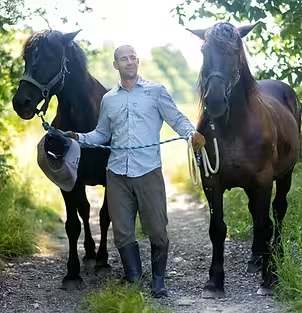
In our last farm news, we shared the loss of our horse Dan, as we stared into an agricultural abyss. After consultation with many family members, farmers, and friends, we decided to retool our 2-horse equipment to 1-horse equipment. The risk was too great to introduce a second unknown horse to our strong-willed, and flat-out strong, remaining horse Doc, without a new set of horse stalls, a small barn, and a barnyard fence.
Fortunately, within a month things were looking promising. We found affordable sources for equipment and alterations, and Doc passed his first major test one late April night — pulling our flock of laying hens and supplies, spread over four separate loads, a quarter-mile uphill into our far field. The laying hens never skipped a beat, taking right to the fresh pasture without a drop in egg production.
As this was unfolding, we borrowed a tractor for a week and a half from our friend and fellow Park farmer, Ben. While it was jarring to witness Ben's generosity and the power of a tractor to transform soils quickly, I returned it looking forward to getting my boots back on the ground and my hands on harness and reins.
Farming with one horse in a hot, humid summer proved very difficult. Relearning to drive Doc — who, unnerved by flies and unmoored from the constraints of cart and Dan, often chose not to go where I tried to tell him — began as a tense exercise in wiggly rows. But with time and patience from all, it morphed into a hopeful new method for growing produce here.
Out of necessity, we now cut a shallow furrow, progressively deeper, leaving the soil friable enough to set a 300-foot row of transplants quickly. After this, a wide swath on both sides of the crop row is mowed periodically by horse or scythe. If mowed by horse-drawn mower, the clippings are raked against and between the bases of a row of transplants. If scythed, the end of the swing deposits the just-cut grass, clovers, forbs, and weeds under the crops without raking — but with the occasional sliced-off tomato or pepper plant.
Where we have made the time and implemented this system best, we are seeing really healthy crops with significantly less work for horses and humans than ever before here.
As we close in on Thanksgiving, I am so grateful for this forced change in direction and I am more excited for growing again next year than I can ever remember.
Looking Ahead
The good news is it doesn't take much to make a small farm work well:
- A committed group of farmers living modestly, but rich with good food and work. — Check.
- A committed community that values such farming. — Check.
- A small group of committed preparers of farm food for their primary nourishment. — Check. (About 50 people per farmer.)
- A small collection of buildings to support said farm. — Incomplete.
This is where we are focusing our energy this winter — developing a plan for early 2025, with a series of options for community investment and donation in this farm beyond the incredible support we already receive.
More soon, including a fun website!
— Mark